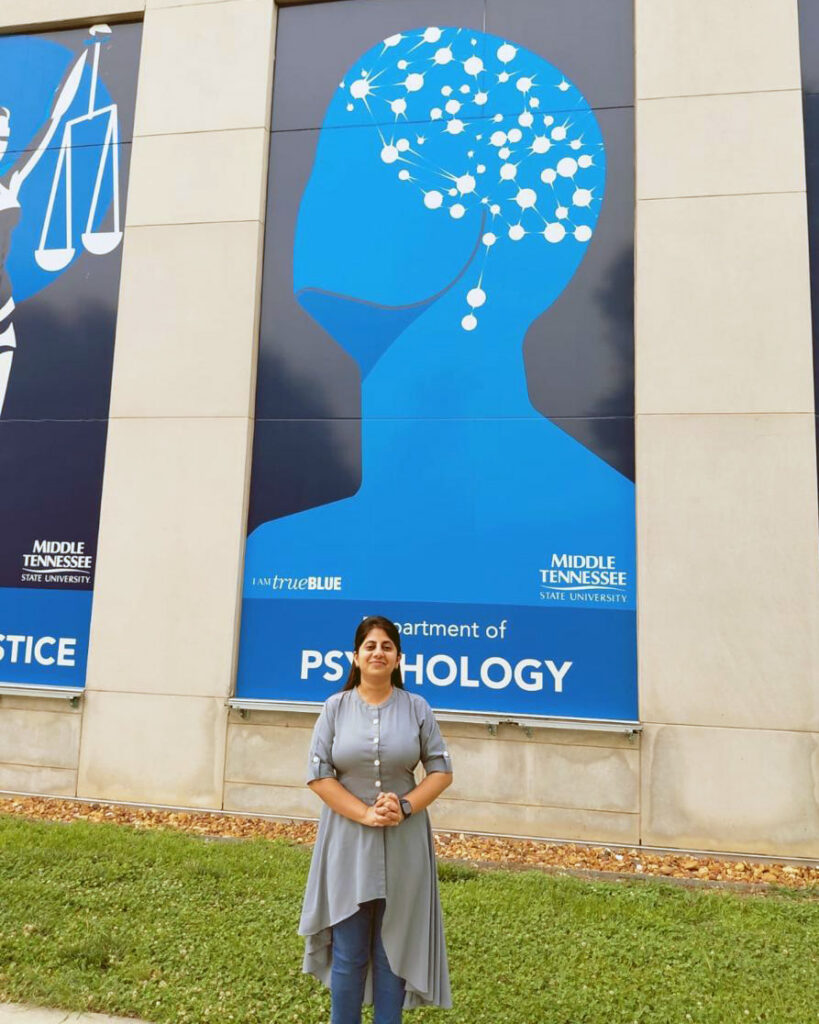
Dr. Meenakshi Shukla is an assistant professor at the University of Allahabad who earned her doctorate in psychology from Banaras Hindu University. For the 2025-26 academic year, she was selected for the Fulbright Program, which allows citizens from around the world to study, conduct research, and teach in other countries. Through the program, she is visiting Middle Tennessee State University, where she is researching how health-related factors, such as high blood pressure, affect emotion recognition and how this impacts Indian immigrants as they adjust to a new cultural setting.
Shukla discovered the Fulbright Program through her network of colleagues and was intrigued by its emphasis on cultural exchange and collaboration. The program spans 160 countries and territories and has given nearly 450,000 participants the opportunity to advance their knowledge in a cross-cultural setting. That resonated with Shukla because it allowed her to take her research on the interaction between mind and body and understand how it affects Indian immigrants in America specifically.
According to her research, elevated blood pressure correlates with difficulty recognizing emotions in others, specifically in facial expressions and sounds. She focuses on how this affects the acculturation strategies of first-generation Indian immigrants and how it may affect their long-term cardiovascular health. For example, smokers often have elevated blood pressure. A first-generation immigrant from India who smokes may have a harder time recognizing emotions than others, which could make social situations difficult to understand and increase feelings of isolation.
Her biggest challenge has been recruiting participants for her lab. Because she is conducting the research on MTSU’s campus, most participants have been younger students. To make the results more generalizable, she wants a wider age range. With five months of research remaining, Shukla will continue recruiting participants and will report her findings.
Despite the challenges, Shukla has enjoyed the fellowship. She said she loves the nature and environment on campus and working with colleagues, especially Dr. James P. Loveless, associate professor of psychology, whose work she had read and admired before the fellowship. She also values how the program pushed her to think about her research from a new perspective.
“Being here has led me to think about the familiar research questions from a different cultural lens. So, that is really something marvelous for me because as a psychologist this challenges your previous assumptions and motivates you to keep an open mind and try to accommodate different viewpoints and ways of thinking,” Shukla said.
After the fellowship, Shukla hopes to use what she has learned to bring attention to how health-related factors affect immigrant populations.
“If we are looking to accommodate the immigrant population and especially be careful about their health conditions and problems, we do need to understand and take into account their physiological factors like blood pressure specifically, and also their psychological understanding, especially related to how they process emotions and understand emotions,” she said.
Shukla looks forward to continuing her research at MTSU. The program allowed her to take her previous research and generalize it to studies that could help the immigrant population overall. Her research runs through November 2026 and will continue to focus on immigrant health and emotion processing. As Shukla put it, “You can’t understand an immigrant’s health without looking at both their blood pressure and how they process emotion.”